Thursday, December 15, 2011

Transportation modes in Singapore

Most people commute using public transport on their daily lives.
There are two major modes - subway and bus services.

SBS Transit is the major public bus line.
http://www.sbstransit.com.sg/

This is the journey planner
http://www.sbstransit.com.sg/journeyplan/step1.aspx

SMRT is another operator of bus services particularly in north west and north east area besides taxi services. It is a listed company in SGX.
http://www.smrtbuses.com.sg/ebusguide/busguide.asp


The subway in Singapore is called MRT (Mass Rapid Train)
This is the current subway network
http://www.smrt.com.sg/trains/network_map.asp

From Changi Airport passenger could be able to board it to the other part of Singapore by alighting in Tanah Merah interchange and board the West bound train (denotes with green line) if commuting to the North, South, Central, and West area.

The North South line is denoted in red line, while the North East line is denoted in purple line, and the latest Circle Line connecting East, Central to the Southwest part of Singapore.

The major interchange stations are Dhoby Ghaut, Raffles Place, Cityhall, Serangoon, Outram Park, and Payalebar.

 The timeliness of trains and buses in Singapore could not be compared with those in Japan

This is the future plan of Singapore subway network


Below is the link of taxi companies in Singapore
http://www.taxisingapore.com/

For those willing to pay here here are more fancy taxies
http://www.limousinecab.com/

Below is the link - I really have no idea how accurate it is since ComfortDelgro just announced to increase its taxi fares
http://www.worldtaximeter.com/singapore
http://www.cdgtaxi.com.sg/news_current_year.mvn?year=2011&cid=2444701

Personally I feel that hiring a cab in Singapore is not that costly if compares it with other developed nations such as Japan and Australia.

One good thing is CDG keeps up with technology i.e passenger could use Iphone Apps to book a cab (provided I know the full address of the building and the pick up area) instead of jamming the operator line desperately looking for a cab during a rainy day or a peak hour.

Happy commuting!

Flora around Marina Bay area

Here are photos I took


Wednesday, December 14, 2011

Istana

Istana is the official presidential resident in Singapore.

Inside the compound there is a lake, presidential office, pond, garden, and huge park.

Every year there is an open house day where public could visit it for free.
Foreigner could enter by paying SGD 1 only.
http://www.istana.gov.sg/content/istana/istana/istanaopenhouse.html

The location is at Orchard Road, to be precise it is next to Plaza Singapura.

Tuesday, December 13, 2011

Biodiversity

I had been long time wanting to write this article

Recently there had been some reports of "new" species found in forests or seas around the globe

Here are photos of camouflaged animals
http://sg.news.yahoo.com/photos/camouflaged-animals-1323369509-slideshow/#crsl=%252Fphotos%252Fcamouflaged-animals-1323369509-slideshow%252Fcamouflaged-animals-photo-1323369385.html

We had been long heard of the biota of Madagascar, Galapagos, Australia, the savannah of Africa, Amazon, and Antartic in those like National Geographic, and similar channels in tv.

I have never known such of biodiversity in Colombia, and those around Mekong River.

In my middle school days, I learnt about Wallacea. It is named after Alfred Russell Wallace 
Many endangered species found like Komodo dragon, anoa, babirusa, and many of insects, lizards, flowers, reptiles, birds...
http://en.wikipedia.org/wiki/Wallacea
http://en.wikipedia.org/wiki/Alfred_Russel_Wallace

In Papua there also many species which are not found in other parts of Indonesian archipelago such as Matoa which is a bigger version of longan (buah mata kucing/lengkeng/ kelengkeng), has a specific fragrant, thicker, not as sweet as longan
http://en.wikipedia.org/wiki/Longan
(i will need to search my archive of photos of Matoa)

The land of Borneo now facing a mass destruction of its rainforest. We had seen those damaged in Java and Sumatera. Local tribes eventually have to merge with migrant villagers, and they are often being cast aside from the societies.

We heard the stories of orangutan. They are indeed intelligent creatures.
I went to Sarawak in 2009. 
http://en.wikipedia.org/wiki/Orangutan
http://en.wikipedia.org/wiki/Bornean_orangutan
http://www.youtube.com/watch?v=VNPSmo3nTNY&noredirect=1
http://savetheorangutan.org/splash.html

The locals (read: companies) clear the land with primitive method which is the cheapest way to do is to burn it down. It creates fogs blown away to the whole tiny red dot neighboring country. I wish the companies could deploy a much better and safer way to do so.

One way to help is to cut down the fried food intakes. Most of junk food chains use cooking oil. If 1 person cuts down those food intakes by 30%, multiply by 1 billion person in a year, I believe it would help stopping the expansion of palm oil plantation and the similar plantation which later processed into cooking oil (sunflower, canola, olive, etc).
I am not asking people to boycott the cooking oil totally.

Eventhough there is new technology such as air fryer which claimed cooking without oil, there are still more 1 billion people who could not afford to pay the electricity bills and the purchase of such home appliance.

By pace of global warming, will these species eventually silenced into extinction?

I wish I could visit these places from they are gone or before I die...

Monday, December 12, 2011

Travel Volunteer

This is currently my favorite blogs on a couple of tourist who were chosen to do 100 days to travel in Japan.
http://travelvolunteerblog.net/

I particularly like this article. Please also read wikipedia on WWII. With a strong sense of nationalism, people fought the war. It was a force drive by the greed, the lust, the gluttony, and others of the 7 deadly sins.
http://travelvolunteerblog.net/2011/11/18/there-is-a-light-and-it-never-goes-out/

There were a number of volunteers helping as tour guide, driver, hotel accommodation, and others.

It was surely sad to hear the demise of people in those coastal towns being whipped off the waves suddenly and vanished.
It was sad to hear stories of those people now still living as refugees.
There is a hope that the area will be safe one day.

Cheers to Jamie and Kathy, and the Travel Volunteer team!

Sunday, December 11, 2011

Marina Bay - Singapore

I signed up for a photography class.

Here are some of the pictures I took

Anderson Bridge
安德逊桥


Cavenagh Bridge
加文纳桥

Cavenagh Bridge
加文纳桥


Marina Bay Sands - view from a park outside Victoria Concert Hall


Under the bridges connecting the Victoria Concert Hall and ACM
to the Merlion at Fullerton One and the Esplanade 


the Outdoor Theatre of the Esplanade


The Gamelan (Javanese traditional musical instrument)


The outdoor theatre


The stage


The sound system and lighting


The Booth


the da:ns festival 2011 logo


Boat passing by MBS (viewed from Esplanade)


MBS (viewed from Esplanade)


The Singapore Flyer


The floating platform, the Esplanade, Marina Mandarin Hotel,
and Suntec City in the background


The Helix Bridge

The Helix bridge - details


The ArtScience Museum at MBS


The Clock, MBS


The Clock on the sunset


The Clock with Floating Platform in the background


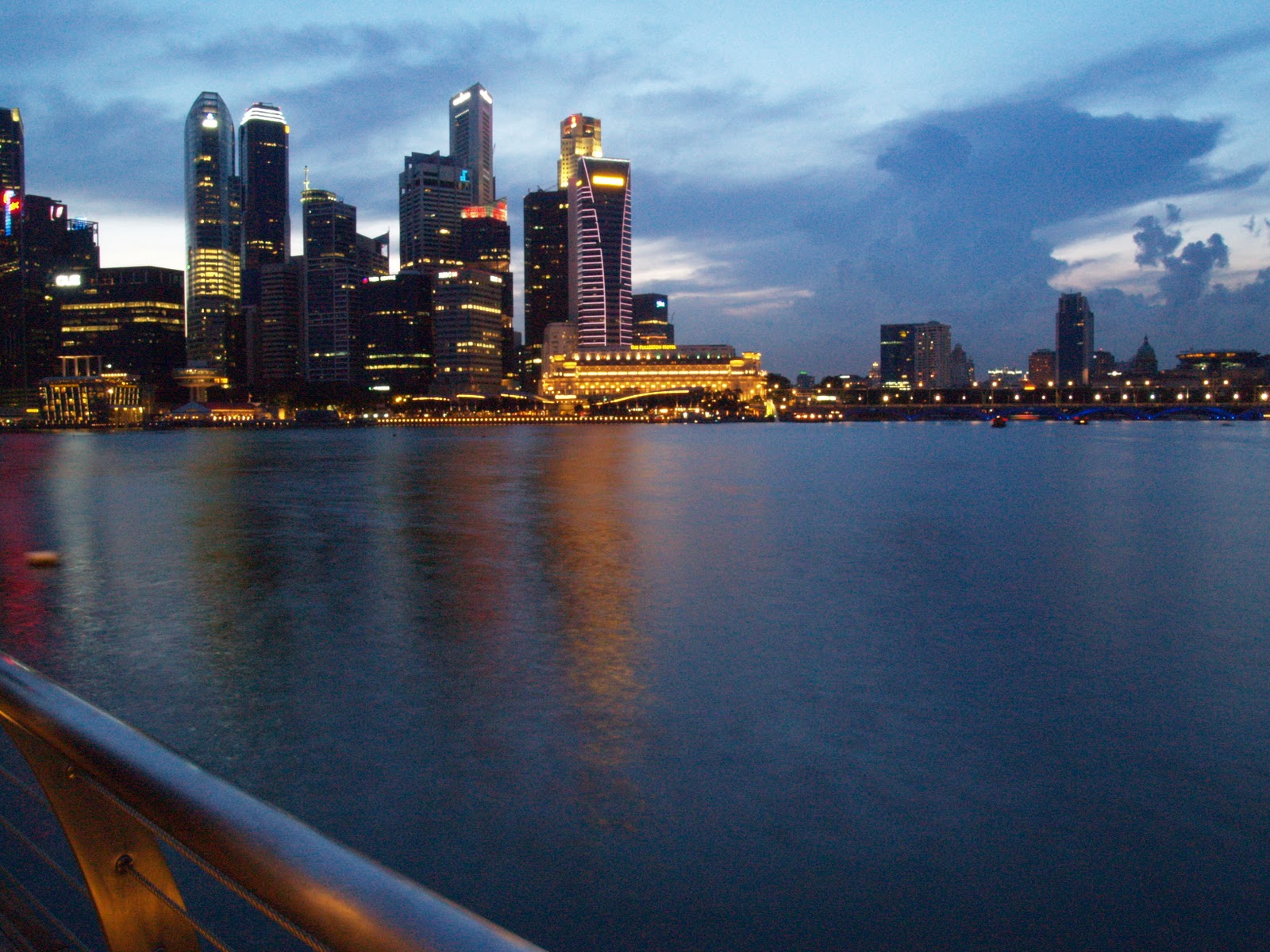
Raffles Place CBD on sunset


The Esplanade on sunset


The lights at Marina Bay


Raffles Place CBD on sunset (almost over)


MBFC (Marina Bay Financial Centre)


Night view


LV shop at MBS


Thursday, December 8, 2011

Transportation in Kansai: Kansai Thru Pass vs JR West Pass

My justification on the transportation in Kansai:


JR West Pass is good for traveling between cities, but not really useful if you intend to explore the city. It would be a great savings if you travel from Kansai Airport directly to Kyoto, or if you would like to travel from Osaka to Himeji.

JR West Rail Pass Kansai Area
1 day
2,000 Yen
2 consecutive days
4,000 Yen
3 consecutive days
5,000 Yen
4 consecutive days
6,000 Yen
Reduced rates (50% off) apply to children aged 6-11.


Kansai Thru Pass can be used for bus and non JR trains and cable cars in Kyoto, Kobe, Koyasan, Osaka, Ikoma, but not valid for bus in Nara. We could use it to travel in Osaka's subway lines on unlimited basis.
We could buy it at a counter in Kansai Airport then showed our bording pass and passport.
It would be good if one used to cover some long distances, could be used on non consecutive days, and convenient rather than use coins.


Kansai Thru Pass
Kansai Thru Pass 2 Day Ticket
3,800 Yen
Kansai Thru Pass 3 Day Ticket
5,000 Yen
Reduced rates (50% off) apply for children aged 6-11.


After one utilized for 1 day, one could see the day printed behind you pass. And it gives certain discounts like temples entrance, or JPY50 discount for Kobe sightseeing bus even the card is not yet activated because you just need to board the bus first then showed it to the female attendant at the entrance of the bus...

When in Osaka i used Osaka unlimited pass which is useful, and on other days just used coins to pay for short distances on other days.

If would like spend more time in Kyoto better buy the combination pass for bus and subway.
http://www.city.kyoto.jp/koho/eng/access/transport.html

In some places like imperial palace, one can commute by different bus number to Ginkakuji (East) and Kinkakuji (North)

I used Kansai Thru Pass 3 day to travel from Sanjo Kyoto to Shin Osaka and on the same day I used to visit Imperial Palace, Fushimi Inari, Ginkakuji, Kinkakuji.
The next day I covered Shin Osaka-Koyasan-Shin Osaka via Namba. And on my 3rd day utlizing it, I travelled from Shin Osaka-Namba-Ikoma-Nara-Namba-Kansai Airport
 
Just buy the pass at the airport using cash then show your passport to the attendant. check out hyperdia too to justify your own decision ^_^